Millions of Americans avoid the dentist every year not because of cost, but because of fear.
If you’ve ever Googled what does a cavity look like at midnight while probing a suspicious dark spot on your tooth, you’re far from alone.
The intersection of dental health and dental phobia creates a vicious cycle that our team finds deeply underreported.
Key Takeaways:
- A cavity’s appearance changes dramatically across its stages, from faint white spots to visible dark holes.
- Dental anxiety affects up to 36% of the population, according to research published in the British Dental Journal, and it directly delays cavity detection.
- Understanding what does a cavity look like at each phase empowers you to act before fear takes the wheel.
Why Does This Question Trigger So Much Anxiety?
If you’ve been following psychology and phobia trends, this won’t come as a surprise.
Dental phobia clinically termed odontophobia ranks among the most common specific phobias worldwide.
The National Institute of Dental and Craniofacial Research reports that untreated cavities affect 26% of U.S. adults, and avoidance driven by anxiety is a leading contributor.
When someone searches what does a cavity look like, they’re often performing a self-diagnosis ritual an attempt to determine whether the situation is “bad enough” to overcome their fear and book an appointment.
Our analysis suggests this behavior mirrors what psychologists call safety-seeking behavior, a hallmark of anxiety disorders documented extensively by the American Psychological Association.
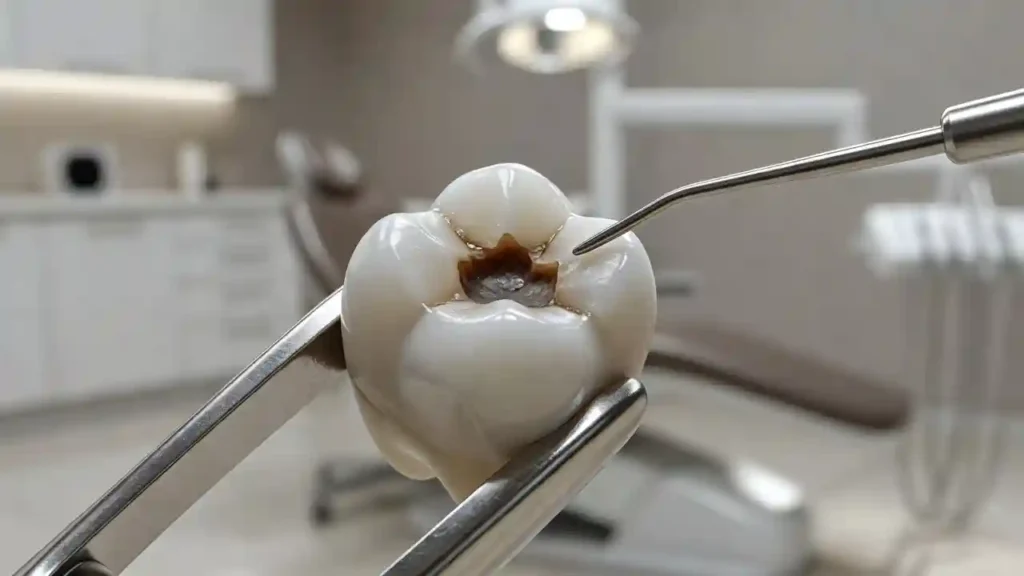
What Does a Cavity Actually Look Like at Each Stage?
Understanding the visual progression is critical.
We’ve broken it down into a clear, stage-by-stage format.
| Stage | Visual Appearance | Symptoms | Reversible? |
|---|---|---|---|
| Stage 1: Demineralization | White or chalky spots on enamel | None or mild sensitivity | Yes, with fluoride treatment |
| Stage 2: Enamel Decay | Light brown or yellowish spots | Occasional sensitivity to sweets | Rarely without intervention |
| Stage 3: Dentin Decay | Dark brown or black spots, small holes visible | Pain with hot, cold, or sweet foods | No — filling required |
| Stage 4: Pulp Involvement | Large visible hole, dark discoloration | Severe, throbbing pain | No — root canal likely needed |
| Stage 5: Abscess | Swelling, pus near gum line, broken tooth | Intense pain, fever, swelling | No — emergency treatment |
According to the Centers for Disease Control and Prevention, cavities remain the most common chronic disease in both children and adults in the United States.
So knowing what does a cavity look like at Stage 1 versus Stage 4 can literally save your tooth.
Varus Stress About Your Body and Mind
How Does Fear Change What You See?
Here’s where psychology enters the conversation in a powerful way.
Research from the Journal of Anxiety Disorders shows that anxious individuals tend to catastrophize ambiguous physical symptoms.
A harmless stain becomes “definitely a cavity.”
A cavity becomes “I’m losing all my teeth.”
This cognitive distortion feeds avoidance, which allows actual cavities to worsen silently.
Industry insiders in behavioral dentistry are noting a sharp rise in patients presenting with advanced decay not because they didn’t notice symptoms, but because fear paralyzed their response.
Centrifugal Stress Quietly Damages Your Mental Health
Steps to Take If You Suspect a Cavity
If you’ve identified something suspicious after learning what does a cavity look like, follow these steps:
- Document what you see. Take a well-lit photo of the tooth using your phone’s camera and flash.
- Rate your anxiety. On a scale of 1–10, acknowledge your fear level honestly. The Anxiety & Depression Association of America offers free screening tools.
- Contact a “fear-friendly” dentist. Many practices now specialize in patients with dental phobia, offering sedation options and gradual exposure protocols.
- Reframe the narrative. Remind yourself: early cavities are simple fixes. A 15-minute filling today prevents a root canal tomorrow.
- Bring support. A trusted friend in the waiting room reduces physiological stress responses, per findings reported by the Mayo Clinic.
What Does This Mean for Your Long-Term Health?
Knowing what does a cavity look like isn’t just a dental question it’s a mental health question.
The shame-avoidance-worsening cycle that phobia creates around cavities mirrors patterns we see in health anxiety broadly.
Our team believes this conversation deserves more visibility.
The mouth is not separate from the mind.
More Info to Visit Ombrophobes